How the Science of Learning Actually Improves ACT Scores
In my first year of teaching, I had an experience that stung enough to change how I teach.
I was sitting in a bookstore café doing some ACT tutoring when one of my own students walked in and sat at the table behind me with a tutor of her own. I kept working, but I could hear every word. The tutor asked, "And she just told you what the answers were and moved on, right?" My student said, "Yes." The tutor said, "And that's the problem."
She wasn't wrong. We had taken a practice test that week, and I read off the answers as the bell was ringing. I went home frustrated, mostly because I knew there had to be a better way. Nobody else was going to fix it for my students, so the next day I walked into my classroom and did it differently. 15 years ago I knew that simply giving them the correct answers was ineffective and that has not changed since then.
Here's the problem. Telling a student the correct letter confirms where they went wrong, but it does very little to change the thinking that sent them there. The student circles B, maybe writes a quick note in the margin, and moves on with the same faulty reasoning intact. Two questions later, the same misconception shows up wearing a different outfit, and they miss it again.
Rather than emphasizing the wrong, good feedback teaches them what to do next. Learning scientists call this elaborated feedback, and it's one of the most practical shifts a teacher can make during test prep.
Wrong answers are data
ACT distractors aren't random. Test writers build them to look reasonable to a student who is working from a partial rule, making a predictable mistake, or seeing things from the wrong perspective. That means a wrong answer tells you something specific about how the student was thinking.
When I look at a missed question, the selected distractor usually points to one of these:
The student knew the rule and applied it incorrectly.
They answered a different question than the one asked.
They locked onto one detail and ignored the rest of the evidence.
They made a sign, calculation, or unit error.
They chose an answer that was true but unsupported by the passage or data.
They relied on memory instead of going back to the text or graph.
Each of those calls for a different fix. If we only announce the right letter, we skip the diagnosis entirely.
The Three-Part Debrief
For every missed question I want students to review, they answer three prompts:
Correct because: What evidence or rule proves the right answer?
Tempting because: Why did the distractor I chose look reasonable?
Next time: What specific clue or action will keep me from making this error again?
The second prompt is often difficult to answer for students, so they skip it. Naming why a wrong answer looked good is how a student learns to recognize that trap the next time it shows up.
The third prompt needs guardrails. Left alone, students write things like "I need to read more carefully." That sounds responsible, but it is vague and gives them nothing to do differently. I push for observable actions instead:
"I will identify the two quantities before calculating."
"I will read the graph's axis labels and units."
"I will test both sides of the punctuation mark for complete sentences."
"I will return to the lines referenced in the question."
"I will compare my answer with the trend in the data."
If a student can't picture themselves doing it on the next question, it isn't a strategy yet.
Match the feedback to the mistake
Different errors need different responses. A quick sort helps:
Knowledge gap —> Reteach the rule or concept
Misapplied strategy —> Model when the strategy applies
Evidence error —> Point to the overlooked text or data
Execution error —> Find the first incorrect step
Time-pressure error —> Practice a faster decision routine
Distractor trap —> Explain why the choice looked plausible
A student with a knowledge gap and a student who rushed can land on the same wrong letter. Reteaching the rule to the student who rushed wastes both of your time.
What this looks like with a real item
Science is optional on the redesigned ACT, but the skill in this example travels. Reading a data table and refusing an answer that overreaches shows up across sections.
Students look at these results:
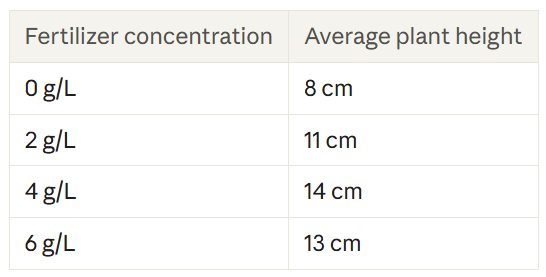
Which statement is best supported by the results?
A. Plant height increased continuously as fertilizer concentration increased.
B. The greatest average plant height occurred at 4 g/L.
C. Plants receiving 2 g/L and 6 g/L reached the same average height.
D. Fertilizer concentration had no observable relationship with plant height.
The answer is B.
The quick review
"B is correct because 14 is the greatest height."
That's accurate. It also leaves the student who chose A exactly where they started.
The elaborated review
Why B is correct. The greatest value in the height column is 14 cm, and it lines up with 4 g/L.
Why A is tempting. Height climbs from 0 to 2 to 4 g/L, so it's natural to assume the pattern keeps going. It doesn't. Height drops from 14 cm to 13 cm at 6 g/L, and the word continuously sinks the whole answer.
Why C is wrong. The values are close, 11 cm and 13 cm, but they aren't equal.
Why D is wrong. Height changes across the concentrations, so the data can't support a claim of no relationship.
The next-time strategy. When an answer uses absolute words like always, never, continuously, or no relationship, check every data point before you choose it.
Close the loop
Here's the step that most reviews skip. After the explanation, students try a parallel question right away:
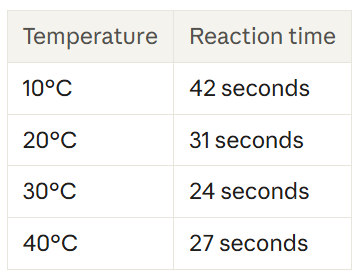
Which statement is best supported?
A. Reaction time decreased continuously as temperature increased.
B. The shortest reaction time occurred at 30°C.
C. Reaction time was identical at 20°C and 40°C.
D. Temperature did not correspond with any change in reaction time.
The answer is B again. Reaction time improves through 30°C and then reverses at 40°C, so it asks for the same reasoning in a new context. Without that second attempt, I have no way of knowing whether my feedback actually changed anything.
A seven-minute routine
None of this requires a full class period. Here's the routine I recommend for one well-chosen question after a practice set:
Minute 1: Students answer the item on their own.
Minute 2: Reveal the answer without explaining it.
Minutes 3–4: Students write their "Correct because" and "Tempting because" responses.
Minute 5: Partners compare the evidence they used.
Minute 6: Each student writes a specific "Next time" action.
Minute 7: Students solve the parallel item.
Collect only the "Next time" statements. In about thirty seconds of reading, you'll see who walked away with a usable strategy and who wrote a vague promise to try harder.
Make it reusable
To make the routine stick, I give students a Distractor Debrief Mat with four boxes:
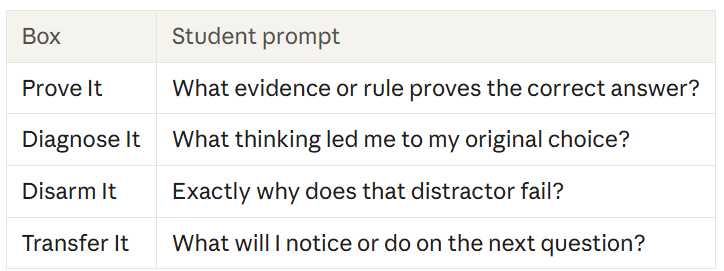
At the bottom sits a short error-code menu so students can label their own mistakes:
K: Knowledge or rule gap
S: Strategy-selection error
E: Evidence overlooked
X: Execution or calculation error
T: Time-pressure decision
D: Distractor trap
One important note: use the mat on a single carefully selected question per practice set. Running it on every missed item burns students out fast. A focused routine they repeat often will do more for them than an exhaustive one they dread.
Zoom out: this was never just about the ACT
I use the ACT as my example because the distractors are so deliberately built, which makes the thinking behind a wrong answer easy to see. The principle underneath it applies to every classroom I walk into.
Think about how feedback usually works in a regular week. A quiz comes back with a score at the top, or a student solves a problem on the board and we say "Good" or "Not quite" and call on someone else. In each case the student finds out whether they were right. Very rarely do they find out why, and almost never do they get a second shot at a similar problem before the class moves on.
The research here is clear and has been for a while. Butler and Roediger (2008) found that feedback after a multiple-choice test boosted later recall of correct answers and cut down on students repeating the wrong answers they had been exposed to. That second finding matters for every teacher who gives a multiple-choice quiz. Without feedback, the lures stick around in students' memories.
A follow-up study by Butler, Godbole, and Marsh (2013) compared feedback that simply gave the correct answer with feedback that explained it. On repeated questions, both worked about equally well. On new questions that required students to apply the idea, the explanation group came out ahead. If our goal is for students to handle a problem they haven't seen yet, the explanation is where the learning happens.
So the Three-Part Debrief works anywhere:
In an English class, a student explains why the thesis they chose for a practice prompt was too narrow.
In history, a student names the detail in a primary source that should have tipped them off to the author's bias.
In math, a student finds the exact step where a negative sign got dropped, and then solves a parallel problem.
In science, a student explains why their hypothesis overreached the data, just like answer A above.
The content changes. The move stays the same. Students prove the right answer, explain the wrong one, name a specific action for next time, and then try again. That's elaborated feedback, and it's one of the cheapest, most effective upgrades available to any teacher willing to slow down for seven minutes.
The sticky takeaway
Don't stop at the right answer. Find the wrong thinking, correct it, and test it again.
The answer key will always tell students what was correct. Our job is to make sure they leave knowing what to do differently on the next one. That's where growth shows up, on the ACT and everywhere else.
Try the routine with one question this week and let me know how it goes.
- Ashly
